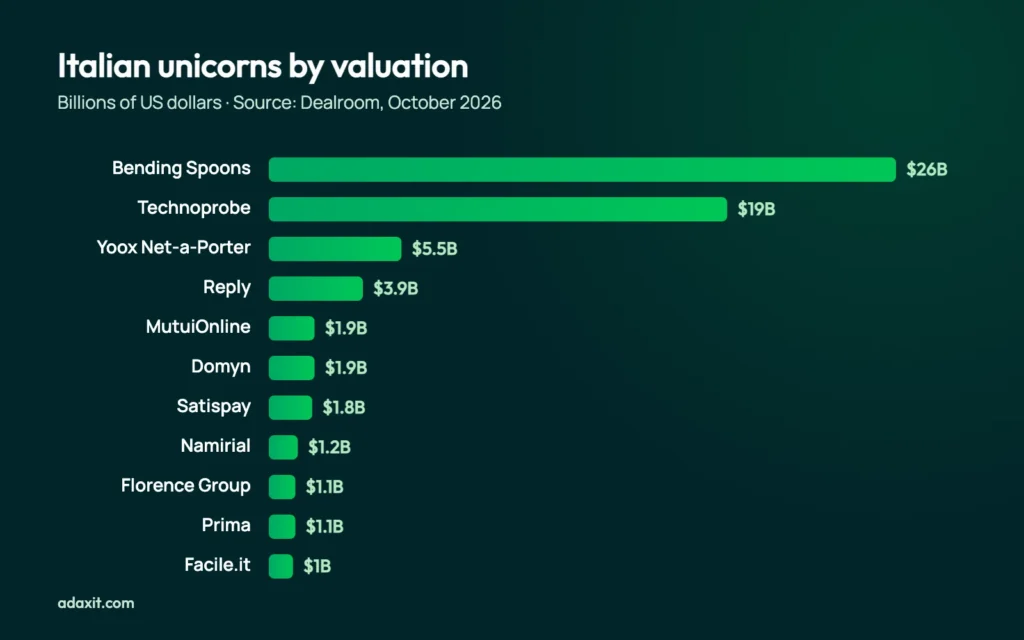
Eleven. That’s how many Italian companies are worth a billion dollars or more right now, going by Dealroom’s October 2026 numbers. Two of them carry most of the weight: Bending Spoons, the Milan app company that went public on Nasdaq on June 30, and Technoprobe, a maker of chip-testing gear from a small town in Lombardy. Add up the other nine and you still don’t reach those two.
Is eleven a lot? Not really. France, Germany and the UK each have dozens. What makes the Italian list worth a closer look is how differently these companies got there, and what that means for anyone raising money here today. Full list first, then a quick profile of each, then the lessons.
In short
- Italy has 11 companies valued at $1 billion or more (Dealroom, October 2026).
- Bending Spoons is the most valuable, at around $26 billion after its June 2026 Nasdaq listing.
- Eight of the eleven are based in Milan.
- Most took more than a decade to get there, and several are listed or owned by private equity.
New to all this? Read the beginner’s map first: it goes from zero to a first round. Keep the startup glossary in another tab for the jargon.
The full list of Italian unicorns in 2026
| Company | Founded | Headquarters | Sector | Valuation* |
|---|---|---|---|---|
| Bending Spoons | 2013 | Milan | Software (apps) | $26B |
| Technoprobe | 1993 | Cernusco Lombardone | Semiconductors | $19B |
| Yoox Net-a-Porter | 2000 | Milan | Luxury e-commerce | $5.5B |
| Reply | 1996 | Turin | IT services | $3.9B |
| MutuiOnline Group | 1999 | Milan | Fintech | $1.9B |
| Domyn | 2016 | Milan | Artificial intelligence | $1.9B |
| Satispay | 2013 | Milan | Fintech (payments) | $1.8B |
| Namirial | 2000 | Senigallia | Digital trust software | $1.2B |
| Florence Group | 2020 | Milan | Luxury manufacturing | $1.1B |
| Prima | 2014 | Milan | Insurtech | $1.1B |
| Facile.it | 2008 | Milan | Price comparison | $1B |
One caveat. Lists of unicorns never fully agree with each other. The Italian Tech Landscape report presented in Milan last April sets the bar at €1 billion and counts nine names, Scalapay among them at €1.1 billion. Dealroom no longer puts Scalapay above $1 billion.
The companies, one by one
Bending Spoons
Odds are you used one of its apps this week without knowing it. Evernote, WeTransfer, Vimeo, Eventbrite, Meetup, even AOL: Bending Spoons owns them all, and its products get more than 500 million users a month. The playbook is buying apps with a loyal audience and rebuilding how they’re run. Founded in 2013, it started trading on Nasdaq as BSP on June 30, 2026, after an offering of about $1.68 billion.
Technoprobe
Outside the semiconductor world almost nobody knows the name. Technoprobe makes probe cards: think of them as extremely fine test instruments that tell a chipmaker whether a chip works before it’s cut from the wafer. Giuseppe Crippa got it going in Cernusco Lombardone, in the province of Lecco. Today it trades in Milan and ships to chip factories all over the world.
Yoox Net-a-Porter
Back in 2000, when hardly anyone in Italy bought clothes online, Yoox launched in Milan anyway. In 2015 it merged with Net-a-Porter from London, and the new group grew into one of the biggest names in online luxury.
Reply
Reply was born in Turin in 1996 and works as a federation of small, specialised consulting firms: cloud, data, AI and so on. It has been on the Italian stock exchange for years.
MutuiOnline Group
If you’ve compared mortgages or car insurance in Italy, you’ve probably met this group through MutuiOnline.it or Segugio.it. Behind the comparison sites there’s a large back-office business serving banks and insurers. Founded in Milan in 1999, it trades on Euronext Milan.
Domyn
Domyn used to be called iGenius. It makes AI systems for companies and public institutions that can’t send their data just anywhere, and it has been based in Milan since 2016.
Satispay
Satispay is the payment app you see on stickers at Italian bars and shops, pitched as a cheaper alternative to cards. Alberto Dalmasso, Dario Brignone and Samuele Pinta launched it in 2013.
Namirial
Namirial is the outlier on the map. It’s based in Senigallia, on the Adriatic, and sells e-signatures, digital identity and similar trust services to companies all over Europe.
Florence Group
Florence Group is a less obvious name: it owns Italian workshops that manufacture clothes for the big luxury houses. It was put together in 2020 and has grown mostly by buying family-run suppliers.
Prima
Prima sells car and motorbike insurance online, and since 2014 it has become one of the best-known digital insurers in the country.
Facile.it
Facile.it started in Milan in 2008 as a comparison site for insurance, energy, mortgages and phone deals. The private equity firm EQT controls it today.
What Italy’s unicorns have in common
- Milan, mostly. Eight of the eleven are headquartered in Milan. The exceptions are Technoprobe (near Lecco), Reply (Turin) and Namirial (Senigallia).
- Time. The median founding year is 2008. Only Florence Group, created in 2020, got there quickly, and it was assembled through acquisitions.
- Not the textbook path. Technoprobe, Reply and MutuiOnline are listed on the stock exchange, while Facile.it, Namirial and Florence Group are backed by private equity. Fewer than half of the eleven grew round after round on venture capital.
- Fintech leads. Four of the eleven are financial services businesses: MutuiOnline, Satispay, Prima and Facile.it.
- Customers abroad. The two biggest sell mostly outside Italy. Bending Spoons’ apps are used around the world, and Technoprobe’s customers are global chipmakers.
Why Italy has fewer unicorns than its neighbours
The short answer is capital. Italian venture capital invested about €1.7 billion in 2025, its second-best year on record, which is still a fraction of what founders can raise in France or Germany. We went through the numbers in our guide to raising capital in Italy.
What’s missing is the big late-stage money. Seed capital is there: business angels, accelerators, public programmes like Smart&Start Italia. But when a scale-up needs €50 million or more, the cheque usually comes from a foreign fund, and plenty of Italian founders end up raising abroad or selling sooner than they’d like.
What it means if you’re raising in Italy
- Plan for a long game. Most of these companies needed ten years or more. Investors know it, and they will ask how you plan to get through the difficult middle years.
- Think beyond Italy early. The biggest names here sell abroad. An Italy-only market can work, but you’ll need to show investors it’s large enough on its own.
- Prepare like money is scarce. It is. With fewer rounds closing every year, the founders who get funded tend to show up with tidy numbers, a short deck and a precise plan for the money.
Adaxit
Adaxit works with founders on fundraising and market entry between Italy, the rest of Europe and the United States.
Frequently asked questions
How many unicorns does Italy have?
According to Dealroom’s October 2026 data, 11 Italian companies are valued at $1 billion or more. The Italian Tech Landscape report from April 2026, which uses a €1 billion threshold and a different method, counts nine.
What is the most valuable Italian startup?
Bending Spoons, valued at around $26 billion by Dealroom after its Nasdaq listing on June 30, 2026. Technoprobe follows at about $19 billion.
Is Satispay a unicorn?
Yes. Dealroom values it at $1.8 billion, and the Italian Tech Landscape report at €1.6 billion.
Which Italian city has the most unicorns?
Milan, home to eight of the eleven companies on Dealroom’s list.
Is Scalapay still a unicorn?
The Italian Tech Landscape report (April 2026) still lists Scalapay at €1.1 billion, but it does not appear among the companies Dealroom currently values at $1 billion or more.
Sources
- Dealroom, Unicorns in Italy, data updated October 2026
- Axios, Bending Spoons raises $1 billion in IPO, July 1, 2026
- ItaliaOggi, report on the Italian Tech Landscape, April 15, 2026
For information only: this is not investment advice or a public offer.