Here’s the strange thing about Italian venture capital right now. The money hasn’t dried up: 2025 was the second-best year on record, with 1.735 billion euros invested. And yet only 145 rounds closed in the first half of 2026. Fewer deals, bigger cheques. If you’re raising, that changes how you should play it.
This guide covers what actually matters: where the market stands, who writes cheques in Italy, which incentives are worth knowing (a couple are genuinely generous), what investors will ask for and how long the whole thing really takes. It’s written for founders working on a pre-seed, seed or Series A round, whether you’re Italian or setting up in Italy from abroad.
Every number comes from official sources or from the quarterly observatory run by Growth Capital and Italian Tech Alliance. The full list is at the end.
Key takeaways
- 2025: €1.735bn of venture capital across 436 rounds. First half of 2026: €813m across just 145.
- Pre-seed and seed were 59% of the deal count in H1 2026. The money, though? Mostly Series A and later.
- Private investors backing an innovative startup get a 65% tax deduction on up to €100,000 a year: the so-called de minimis route, with a three-year lock-in. (Run it past a tax adviser before you quote it.)
- Smart&Start Italia lends between €100,000 and €1.5m at zero interest, and it plays nicely with an equity round.
- Get your deck, model, cap table and data room ready before the first meeting. Then budget four to six months to close.
New to all this? Read the beginner’s map first: it goes from zero to a first round. Keep the startup glossary in another tab for the jargon.
Italy’s venture market: 2025 vs 2026
Start with the headline figures. According to the Growth Capital and Italian Tech Alliance observatory, Italy saw 1.735 billion euros invested across 436 rounds in 2025, and only one year has ever been bigger. Q4 was a monster on its own (901 million over 122 rounds), and ten deals that year cleared the 25 million mark.
€1.735bn
invested in venture capital in Italy in 2025, across 436 rounds
€813m
invested in the first half of 2026, across 145 rounds
12,073
innovative startups in the Italian Business Register at 31 October 2025
Source: Growth Capital and Italian Tech Alliance, quarterly observatory on venture capital in Italy (2025 and H1 2026 data); MIMIT, 2025 annual report on innovative startups and SMEs.
Then 2026 showed up with a different tempo. January to June brought 813 million across 145 rounds, split almost evenly: 411 million in Q1 (69 rounds), 402 million in Q2 (76). Last year Italy averaged 109 rounds a quarter, so that’s a clear drop. The capital is still there; the deals aren’t. Divide one by the other and the average cheque balloons to around 5.6 million, against roughly 4 million in 2025. Granted, a few chunky deals drag the average up. The direction is obvious all the same.
Two details tend to get buried in the coverage, and they shouldn’t. In 2025, not a single round above 20 million closed without at least one foreign investor at the table. And IPOs? Zero. Every single exit went through an acquisition. So what’s the takeaway for a founder? Materials in English, for a start. And a believable answer to the question serious investors always get to eventually: who might buy this company one day?
Fresh money keeps coming in, too. Nine new funds launched in 2025 with 545 million raised between them, and three more followed in the first half of 2026, adding 104 million.
Adaxit note
A shrinking deal count isn’t the same as a shrinking pot. What it does mean is that founders who turn up with clean numbers, a use of funds pinned to milestones, a tidy cap table and a data room that’s ready before anyone asks are winning a bigger share of the deals.
Round stages and how much to ask for
A useful mental model: every round pays for one milestone, nothing more. Pre-seed money proves the problem is real and that your team can crack it. Seed money proves the product works for actual customers. Series A proves growth can be repeated, profitably. From Series B on, you’re paying for scale, very often outside Italy.
| Stage | What you must prove | Typical sources | Capital raised in Italy, H1 2026 |
|---|---|---|---|
| Pre-seed | That the problem exists and the team can solve it | Founders, business angels, accelerators, Smart&Start Italia | €37m |
| Seed | That the product works, with first customers | Business angels, seed funds, equity crowdfunding | €135m |
| Series A | That growth is repeatable and sustainable | Venture capital funds, corporate venture capital | €276m |
| Series B+ | That the model holds at scale, including abroad | Italian and foreign funds, corporates, venture debt | €274m |
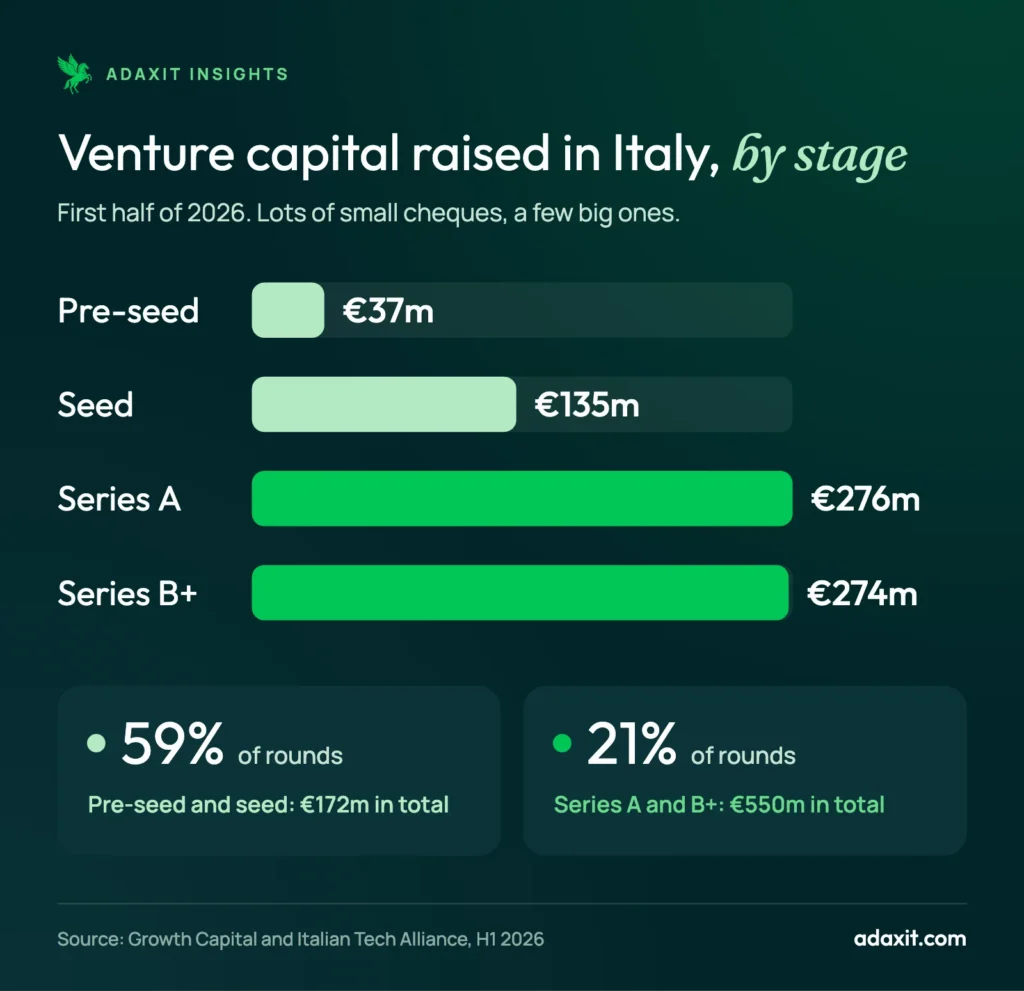
Look at the split in the first half of 2026. Pre-seed and seed were 59% of all rounds yet pulled in 172 million, roughly a fifth of the total. Series A and B+ were just 21% of deals and took 550 million. Lots of small cheques, a few big ones.
How much to ask for
There’s no magic figure for each stage, and frankly anyone who quotes you one without looking at your plan is guessing. Flip it around. Begin with the milestone. Ask what needs to be true for the next round to happen, cost it out, then add a cushion, because something always slips (hiring, usually). As a rule of thumb, aim for 18 to 24 months of runway. Undershoot, and you’ll be back on the roadshow before there’s anything new to show. Raise too much without a plan behind it and you pay twice, in dilution and in credibility.
Sources of capital in Italy
Most founders end up mixing three things: private capital, public instruments and some form of debt. Here’s how each tends to work in Italy.
Business angels and angel networks
Usually the first outside money a startup takes. It’s their own cash on the line, and the better ones throw in experience and a well-thumbed contact list. Lots of them go in through angel networks and clubs, which host pitch evenings and pool tickets together. They move fast. They also run out of firepower by the later rounds, so plan for that. And the tax incentive (more on it below) weighs heavily in their decision.
Venture capital funds
A fund invests other people’s money (pension funds, foundations, family offices) and has to give it back, with a return, by a fixed date. That single fact explains most of how VCs behave: they need companies that can grow very large and reach an exit within the fund’s life. Before you email one, read its thesis. Stage, sector, geography and ticket size will tell you in two minutes whether you’re wasting each other’s time.
CDP Venture Capital
CDP Venture Capital calls itself Italy’s leading venture capital manager, with 4.9 billion euros spread across 15 direct and indirect funds. The direct ones back startups; the indirect ones invest in other funds. Applications go through its online pitch platform.
Corporate venture capital (CVC)
Big companies often put money into startups that sit next to their own business. The cheque is only part of it: think first customers, a distribution channel, a factory floor’s worth of know-how. The catch? Exclusivity or right-of-first-refusal clauses so broad they tie your hands. Sign those and you may find other funds (and, years later, would-be acquirers) politely backing away.
Equity crowdfunding
Here you sell shares to a crowd of investors through an authorised platform. The rulebook is European: since the transition period wrapped up on 10 November 2023, every platform runs under Regulation (EU) 2020/1503, with a single licence overseen by CONSOB and the Bank of Italy. By the ministry’s count there were 27 licensed platforms at the end of 2024. That year saw 161 campaigns, a success rate of 86.1% and 112.38 million euros raised in total. It works best when you already have a community and a product ordinary people get straight away.
Fundraising Sprint
In two weeks you get an investor deck in English and your language, a financial model and valuation logic, plus a list of 50 investors that fit your project.
Venture debt and guaranteed loans
Venture debt is a loan for startups that already have equity investors behind them. It buys runway without much dilution (you pay interest and often hand over warrants), but it’s no substitute for a round. On the bank side there’s a quiet perk: innovative startups can tap Italy’s SME Guarantee Fund (Fondo di garanzia per le PMI) for free, through a simplified procedure, and get up to 80% of a loan guaranteed. The ceiling sits at 5 million euros per company until 31 December 2026.
Smart&Start Italia and SIMEST
Smart&Start Italia is the national incentive built for innovative startups, run by Invitalia. Plans between 100,000 euros and 1.5 million qualify, and the deal is a zero-interest loan for 80% of eligible costs, paid back over as long as ten years. All-female teams, teams of under-36s (or a mix of the two) get 90% instead, and so can teams with a PhD who has been working abroad, provided a few conditions are met. Based in the South? Set up in Abruzzo, Basilicata, Calabria, Campania, Molise, Apulia, Sardinia or Sicily and only 70% of the loan goes back; the rest is effectively a grant.
This is where it gets interesting for a raise. Bring equity investors in and part of the loan can be converted into a grant (up to half of what they invest, and never more than half of the incentive). A ministerial decree of 13 July 2026 rewrote parts of the scheme to match the new legal definition of an innovative startup, and it promises a lighter evaluation. Up to the end of 2024 the scheme had taken in 5,163 applications and approved 1,236, roughly one in four. When the new rules take effect, and how to apply, is covered in our guide to Smart&Start Italia.
Growing through exports? SIMEST is worth a look: it’s the Cassa Depositi e Prestiti company that has been financing Italian firms’ moves abroad for more than 30 years, through subsidised loans, equity stakes and its own venture fund. Eyeing South America? Our analysis of the EU–Mercosur agreement for Italian SMEs is a good place to start. And if the public-funding maze feels like a full-time job, that’s what our public funding service is for.
Innovative startup status and tax incentives
In Italy, “innovative startup” (startup innovativa) is a legal status, not a buzzword. It’s reserved for young companies with real innovative content, listed in a special section of the Business Register. On 31 October 2025 there were 12,073 in the register, slightly fewer than the 12,133 at the end of 2024. Innovative SMEs, on the other hand, kept climbing and hit a record 3,161.
The rules changed recently. The old Startup Act (decree-law 179/2012) was largely rewritten by Law no. 193 of 16 December 2024; a MIMIT circular of 29 July 2025 then explained how it works in practice. Double-check you still qualify: Smart&Start, the free loan guarantee and your investors’ tax breaks all hang on it.
What investors get
If you’re a private individual, the de minimis route is the generous one: you can take a 65% deduction from IRPEF income tax on what you invest in innovative startups, on up to 100,000 euros per tax year. So 50,000 euros invested means a deduction of 32,500, at least on paper. The investment can be direct or go through collective investment vehicles that invest mainly in innovative startups, and it has to be held for at least three years. One procedural detail people miss: the startup must file an application on MIMIT’s online platform before the money comes in. On its side, the company can’t receive more than 300,000 euros of de minimis aid over three years.
There’s also an ordinary regime, which companies can use as well, and law 193/2024 strengthened the whole incentive system. MIMIT’s dedicated page, last updated on 22 September 2026, says the de minimis implementing rules are being revised but the measure itself is fully operational.
Watch out
The tax break belongs to your investor, but it quickly becomes part of your pitch. Get a tax adviser to confirm rates, caps and conditions for the year of the investment, and only put in the deck what you’ve actually checked.
Preparation and the fundraising process
What investors ask for
First meetings are won or lost on a handful of documents. Get them ready early and you’ll save weeks, while quietly signalling that you know how to run a company.
- Pitch deck. Roughly a dozen slides telling a single story, from the problem and your fix to market, traction, business model, competitors, team, numbers, the ask and what you’ll spend it on. If there’s a single foreign fund on your list, you need it in English.
- Financial model. Three to five years of projections, monthly for at least the first 18 to 24 months, with the assumptions spelled out and a few scenarios.
- Cap table. Who owns what today, any convertibles, incentive plans, plus a simulation of how it looks after the round.
- Data room. The dull folder nobody wants to build but everybody asks for: articles of association, the visura (your company register extract), shareholders’ agreements, accounts, key contracts, IP, and evidence that tax and social security payments are up to date.
- Valuation logic. Not a number pulled out of thin air, but the reasoning behind it.
Want a second pair of eyes before you hit send? Our pitch deck review gives you detailed feedback in five days.
The process in six steps
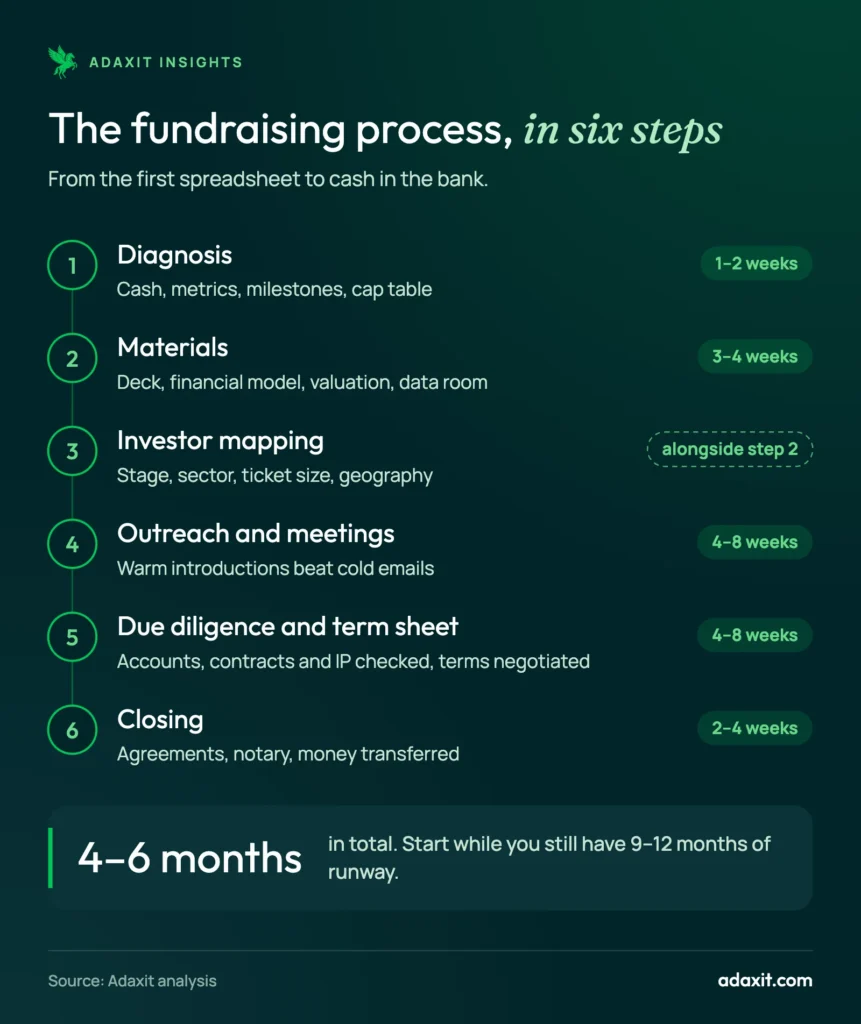
- Diagnosis (1–2 weeks). Look hard at cash, metrics, milestones, cap table and legal status. Decide how much you’re raising, and why.
- Materials (3–4 weeks). Deck, financial model, valuation logic, data room.
- Investor mapping. Do this alongside step two. Draw up a shortlist of investors who really match you on stage, sector, ticket size and geography. A few right names beat a long list.
- Outreach and meetings (4–8 weeks). Warm introductions from people the investor trusts work far better than cold emails.
- Due diligence and term sheet (4–8 weeks). They check your accounts, contracts and IP. Meanwhile you’re haggling over valuation, board seats, liquidation preference, anti-dilution, vesting and the drag-along and tag-along clauses.
- Closing (2–4 weeks). Investment agreement, shareholders’ agreement, capital increase approved before a notary, money transferred.
Add it up and you’re looking at four to six months from the first spreadsheet to cash in the bank. So start while you still have nine to twelve months of runway. Negotiating with three months left is no fun, and investors can tell.
Adaxit note
Honestly? Momentum is half the battle. Drag the meetings out over six months and the round starts to look tired. Each new investor wonders, quietly, what the others saw that made them hold back. Cluster them into a few intense weeks instead.
Valuation, dilution and instruments
Two definitions first. Pre-money is what your company is worth before the new money arrives; post-money is pre-money plus the investment. The investor’s stake is simply the investment divided by the post-money.
Let’s run the numbers. You raise 1 million at seed on a 4 million pre-money. That puts post-money at 5 million: 20% for the investor, 80% left for you and your co-founders. Down the line, a 4 million Series A on a 12 million pre-money takes post-money to 16 million and hands 25% to the new fund. Everyone already on the cap table gets diluted in the same proportion, so the founders drop to 60% and the seed investor to 15%.
| Shareholder | Before seed | After seed | After Series A |
|---|---|---|---|
| Founders | 100% | 80% | 60% |
| Seed investor | – | 20% | 15% |
| Series A fund | – | – | 25% |
| Total | 100% | 100% | 100% |
Real life is messier. A stock option pool created just before the round dilutes the existing shareholders. Convertibles convert. Clauses like liquidation preference change who gets what in an exit. A big headline valuation with heavy terms can easily be worth less than a smaller one with clean terms.
At the early stages there’s no formula, whatever the spreadsheets suggest. Comparable rounds, traction, the team, the market and how much demand there is for your round all play a part. What you need is a logic you can defend: how much, for which milestone, at what dilution.
The most common instruments in Italy
- Capital increase. The bread-and-butter option. The investor subscribes new quotas or shares, normally paying a premium on top that reflects the valuation. It needs a shareholders’ resolution, signed off before a notary.
- Classes of quotas or shares. These give investors different rights from the founders’, on voting, distributions or exit for instance. An innovative startup set up as an S.r.l. can create them too.
- Participating financial instruments (SFP). They carry economic and sometimes administrative rights without making the holder a shareholder.
- Convertible instruments. The American SAFE doesn’t translate directly into Italian law. Founders use an advance towards a future capital increase or a convertible loan instead, with a discount or a valuation cap for early investors. Draft it with a lawyer and run it past the notary.
Common mistakes and a final checklist
Funny thing: most fundraising mistakes have nothing to do with the product. They’re about how the raise is run.
- Starting late. Little cash means you negotiate on the back foot.
- Asking for a number with no milestone attached. “We need two million” isn’t a plan. “Two million gets us to the revenue that justifies a Series A” is.
- Writing to everyone. Twenty targeted introductions beat a hundred generic emails, every time.
- A messy cap table. Departed co-founders holding big stakes, promises nobody wrote down, handshake deals. In due diligence, each one becomes a problem.
- Treating incentives as capital. Smart&Start covers 80% or 90% of eligible costs with a loan. You still fund the rest yourself or with investors, and the loan gets repaid, apart from any grant portion.
- Promising tax breaks you haven’t verified. Nothing burns trust faster.
The checklist before you start
- You’ve got at least nine to twelve months of cash.
- You know which milestone the round pays for and how many months it buys.
- Deck and financial model are ready, in English too if you need it.
- The cap table is up to date, with a post-round simulation.
- The data room is organised and complete.
- Your innovative startup status and your investors’ incentives have been checked.
- You have a list of investors who fit, and a valuation logic you can defend.
- You’ve looked into Smart&Start and other public instruments.
Investor readiness test
Are you ready to meet investors? Answer 12 questions in about 4 minutes and get a score from 0 to 100, with the area to fix first.
Questions founders often ask
How long does closing a round in Italy actually take?
Honest answer: it depends on your stage and on how much homework you’ve done. Ballpark: four to six months for a well-run process, from the first draft of the deck to signing at the notary’s office. Start with plenty of cash in the bank.
Should I go to business angels or try equity crowdfunding?
Why not both? Angels make up their minds fast and usually bring know-how; crowdfunding comes into its own when there’s a community cheering for you. Plenty of Italian rounds mix the two, with a lead investor setting the terms and a campaign topping it up.
Can I combine Smart&Start Italia with a capital increase?
Yes, and it’s smart to plan them together, because equity investment can turn part of the subsidised loan into a grant. The July 2026 decree spelled out which investments count, so check the version of the rules in force on the day you submit.
Do people who invest in my startup get a tax break?
Often, yes. Under the de minimis scheme, a private individual can knock 65% of what they put in off their IRPEF income tax, on up to 100,000 euros a year, provided they keep the shares for three years or more. Companies aren’t left out; they go through the ordinary regime instead. There’s plenty of small print, though, so get a tax adviser to look at your case before anyone banks on the saving.
How big a slice of the company will investors take?
It comes down to two numbers: the amount you raise and your pre-money valuation. Divide the investment by the post-money (pre-money plus the new cash) and you have the investor’s stake. So 1 million in on a 4 million pre-money gives a 5 million post-money, and 20% of the company changes hands. And remember that every later round dilutes everybody again, you included.
Does Adaxit raise capital on behalf of my startup?
No. Adaxit doesn’t provide investment services, doesn’t raise money on behalf of clients and doesn’t promote public offers. Our job is getting you ready: the materials, the model, a valuation you can defend, the right investor list and a few rounds of tough rehearsal. Sound useful? Drop us a line.
Sources
- Financecommunity — Venture capital, 1.735 billion euros invested in Italy in 2025 (Growth Capital and Italian Tech Alliance), in Italian, accessed 1 October 2026
- Financecommunity — Venture capital, 813 million euros invested in Italy in H1 2026 (Growth Capital and ITA), in Italian, accessed 1 October 2026
- Italian Tech Alliance — Software and biotech push investments to €813 million, in Italian, accessed 1 October 2026
- MIMIT — 2025 annual report on innovative startups and SMEs (17 February 2026), in Italian, accessed 1 October 2026
- MIMIT — De minimis incentives for innovative startups and SMEs, in Italian, accessed 1 October 2026
- MIMIT — Support for innovative startups (Smart & Start Italia), in Italian, accessed 1 October 2026
- CDP Venture Capital — Official website, accessed 1 October 2026
- SIMEST — Official website, accessed 1 October 2026
- EUR-Lex — Regulation (EU) 2020/1503 on European crowdfunding service providers for business, accessed 1 October 2026
For information only: this is not investment advice or a public offer.