The first time most founders read “fully diluted” on a term sheet, it sounds like legal boilerplate. It isn’t. It decides what your percentage is measured against, and it’s one of the main reasons the number you had in your head doesn’t match the closing cap table.
The idea is simple once you see it on a cap table, so let’s do exactly that.
In short
- Fully diluted counts the shares already issued plus every share that could be issued: granted options, warrants, the unallocated option pool and convertibles that will convert.
- Your fully diluted stake is always the same as, or smaller than, your stake in issued shares.
- Rounds are priced on a fully diluted basis, so the pool and converting SAFEs come out of your percentage, not the investor’s.
- Ask for the fully diluted cap table before and after the round, and check what’s in it.
New to all this? Read the beginner’s map first: it goes from zero to a first round. Keep the startup glossary in another tab for the jargon.
Issued shares vs fully diluted
Issued shares are the ones on the shareholder register today. Fully diluted adds everything that can still turn into shares: options already granted to employees, the part of the option pool nobody has been given yet, warrants, and SAFEs or notes that will convert at the next round.
Cooley GO describes it as the total common shares, counting not only those issued and outstanding but also the ones that could be claimed through conversions and the exercise of options and warrants. Depending on the deal, it often includes the unallocated pool too.
An example cap table
Two founders own 8,000,000 shares. The company has granted 400,000 options, keeps another 600,000 in the pool for future hires and has a SAFE that will convert into about 1,000,000 shares at the next round.
| Holder | Shares | % of issued | % fully diluted |
|---|---|---|---|
| Founders | 8,000,000 | 100% | 80% |
| Options granted | 400,000 | – | 4% |
| Unallocated pool | 600,000 | – | 6% |
| SAFE (on conversion) | 1,000,000 | – | 10% |
| Total | 10,000,000 | 100% | 100% |
Nothing changed on the register, yet the founders went from 100% to 80%. The options, the pool and the SAFE are all claims on the company that will become shares sooner or later, and investors count them from day one.
Why investors price on a fully diluted basis
An investor buying 20% wants 20% of everything, including shares that will only exist next year. So the price per share is set on the fully diluted pre-money: the pool and the converting SAFE are counted before the new money comes in.
Say a fund puts in €2M at €8M fully diluted pre-money. The price is €8M ÷ 10,000,000 = €0.80 a share, so the fund buys 2,500,000 shares. After closing there are 12,500,000 shares on a fully diluted basis: the investor owns 20%, the founders 64%, the SAFE holder 8% and options plus pool 8%.
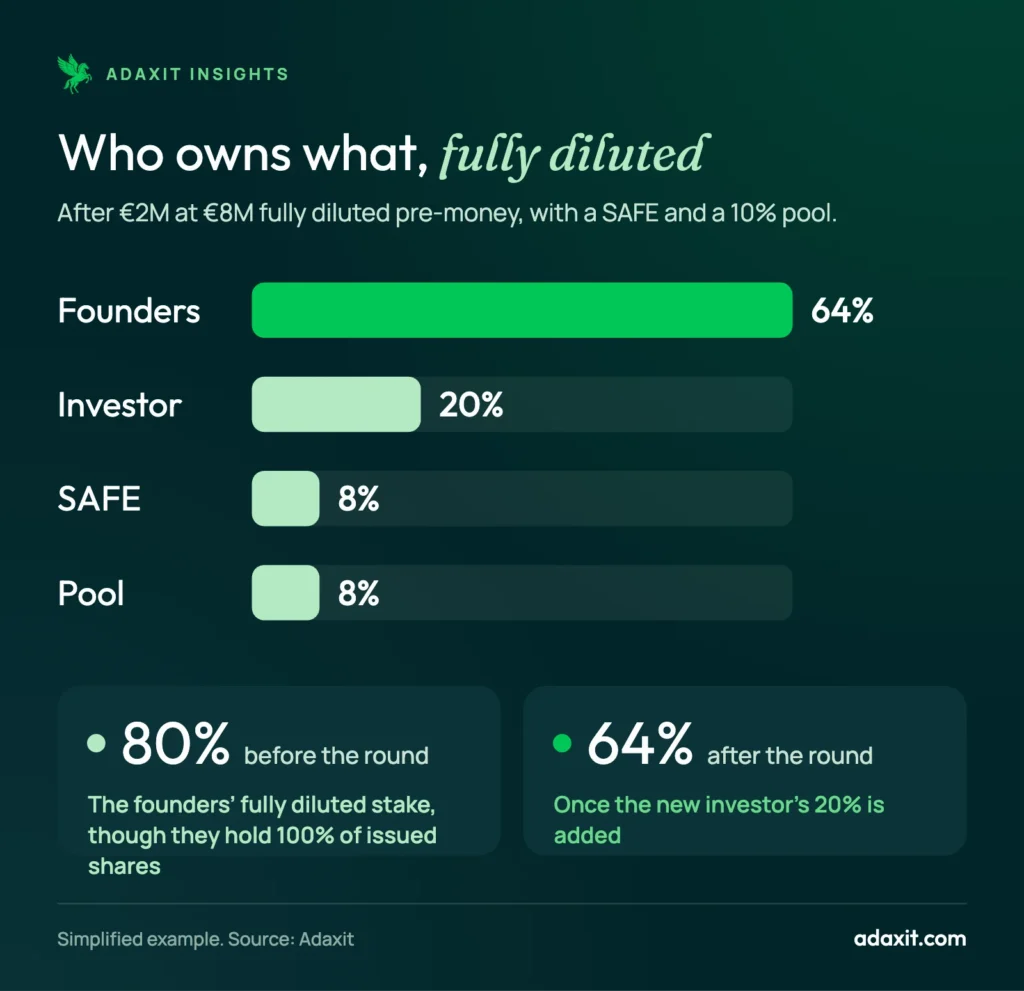
If the investor also asks to top up the pool before the round, that comes out of the 64% as well. It’s the same mechanism we walked through in pre-money vs post-money valuation.
What to check before you sign
- The fully diluted cap table before and after closing, with every holder listed.
- What’s included: granted options, the unallocated pool, warrants and each SAFE or note, with its cap or discount.
- How big the pool is after the round, and the hiring plan that justifies it.
- Whether any side letters or advisor agreements promise shares that aren’t on the cap table yet.
If something you’ve promised isn’t in the fully diluted count, it will come out of someone’s percentage later. Usually yours.
The other clause that changes what you take home is the liquidation preference. For the percentages founders usually sell at seed, and how big option pools tend to be, see how much equity to give away at pre-seed and seed.
What does fully diluted mean?
It’s the total number of shares counting not only those already issued, but also options, warrants, the unallocated option pool and convertibles that will turn into shares. Ownership percentages in a round are usually measured against it.
Does fully diluted include the unallocated option pool?
In venture term sheets it usually does, but check the definition in your documents. Including the pool lowers the founders’ percentage and the price per share.
Are SAFEs counted in the fully diluted cap table?
Once they convert in a priced round, yes. Before that, cap tables often show them as estimates based on their cap, so treat those numbers as approximate.
Why is my fully diluted percentage lower than my issued percentage?
Because the total includes shares that don’t exist yet, such as options and converting SAFEs. Your number of shares hasn’t changed, only the base you’re measured against.
Investor-Ready Kit
See your own fully diluted cap table round by round: the simulator in our Investor-Ready Kit covers SAFEs, the option pool and a Series A.
For information only: this is not investment advice or a public offer.