A term sheet lands on your desk: €2M at €8M pre-money. You work it out in your head, get 20%, and feel fine about it. Then the closing cap table shows up and your own stake is a few points lower than you thought.
The arithmetic was right. The trouble is what the €8M already contains, mostly the option pool and any SAFEs that convert at closing. Below we go through one round from start to finish, with real numbers.
In short
- Post-money is pre-money plus the new money, and the investor’s stake is the investment divided by the post-money.
- When the option pool is created before the round, the existing shareholders pay for it, not the new investor.
- SAFEs and notes that convert at closing usually come out of the existing shareholders as well.
- Compare offers on price per share and on your fully diluted stake after closing, not on the headline number.
New to all this? Read the beginner’s map first: it goes from zero to a first round. Keep the startup glossary in another tab for the jargon.
The two definitions
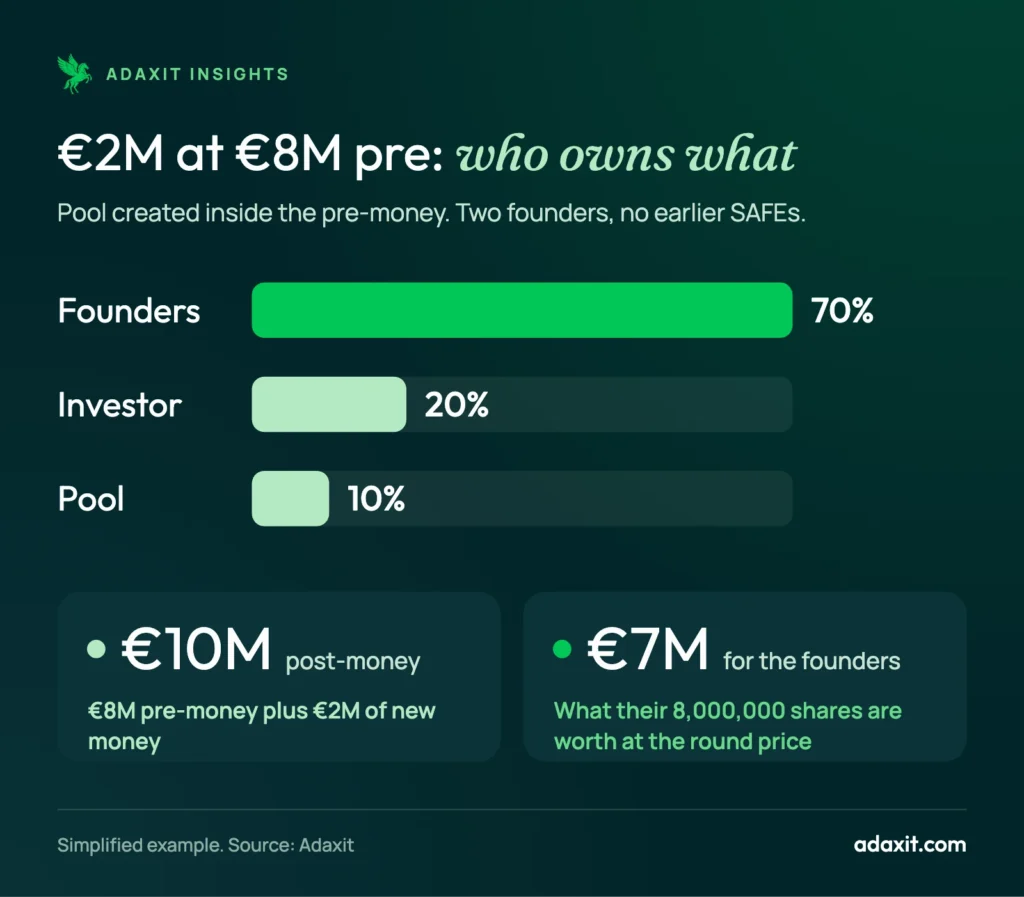
Pre-money valuation is what the deal says the company is worth just before the investment. Add the new money and you get the post-money. So €2M at €8M pre-money means a €10M post-money, and the investor owns 20%.
That 20% comes from a simple division, investment over post-money, and it holds whatever else is in the round. The real negotiation is about who gives up shares to make room for the pool and the convertibles.
One round, two ways to add an option pool
Say two founders hold 8,000,000 shares between them, with no earlier investors and no SAFEs. A fund offers €2M at €8M pre-money and wants an option pool worth 10% of the company after the round.
Funds usually want that pool in place before their money arrives, which means it sits inside the €8M. After closing the founders own 70%, the fund 20% and the pool 10%. The price per share falls to €0.875, so the founders’ 8,000,000 shares are worth €7M at the round price. That €7M is their real pre-money.
Had the pool been created after the round, the price would have been €1.00 a share and the fund would have absorbed part of the dilution. You can guess how often funds agree to that. The practice even has a name: the option pool shuffle.
| Pool inside the pre-money | Pool created after the round | |
|---|---|---|
| Price per share | €0.875 | €1.00 |
| Founders | 70% | 72% |
| Investor | 20% | 18% |
| Option pool | 10% | 10% |
| Founders’ shares at the round price | €7.0M | €8.0M |
Where SAFEs and convertible notes fit
SAFEs signed before your first priced round convert when it closes. Y Combinator’s post-money SAFE fixes the holder’s stake after all the SAFE money but before the new money, so €500k on a €5M post-money cap works out at 10% just ahead of the round.
Those 10 points come out of the founders’ share, and then the new investor’s 20% dilutes everybody, SAFE holders included. Three or four SAFEs in a row can cost founders a quarter of the company before a single share has been priced. Keep a running total.
Three questions to ask about any valuation
- Is the option pool inside the pre-money, and how big will it be after closing?
- Which SAFEs, notes or warrants convert at closing, and at what price?
- What’s the price per share, and what will each founder own fully diluted after the round?
Get clear answers to those three and two term sheets become easy to compare. A bigger headline valuation with a large pool inside it can leave you with less than a smaller valuation and a modest pool.
Two more terms come up in the same conversation: what fully diluted means, and the liquidation preference, which decides who gets paid first when the company is sold. For the percentages investors usually ask for at each stage, see how much equity to give away at pre-seed and seed. If you’re raising in Italy, start with our guide to raising capital in Italy.
What is the difference between pre-money and post-money valuation?
Pre-money is the company’s value just before the new investment; post-money is the pre-money plus the new money. The investor’s stake is the investment divided by the post-money.
How do you calculate the post-money valuation?
Add the new money to the pre-money. €8M pre-money plus €2M of new money gives €10M post-money, so the investor owns 20%.
Is the option pool included in the pre-money valuation?
Usually, yes. Investors ask for the pool to be created or topped up before the round, so existing shareholders absorb the dilution and the effective pre-money is lower than the headline.
Do SAFEs dilute the founders or the new investor?
Mostly the founders. A post-money SAFE fixes the holder’s percentage before the new money, and that percentage comes out of the existing shareholders. The priced round then dilutes everyone.
Investor-Ready Kit
Run your own numbers: the cap table simulator in our Investor-Ready Kit shows the pre-money, the post-money, the pool and every SAFE on one page.
For information only: this is not investment advice or a public offer.