Valuation decides how much of the company you sell. The liquidation preference decides who gets paid first when the company is sold. In a big exit it barely matters. In a modest one it can decide whether the team walks away with something or close to nothing.
Here’s how it works, with one sale run through four different terms.
In short
- A liquidation preference lets investors get their money back before common shareholders when the company is sold or wound up.
- 1x non-participating is the market standard: the investor takes either their money back or their percentage of the sale, whichever is higher.
- In Carta’s data, only 3% of seed and Series A deals had a preference above 1x last year.
- Participation and multiples above 1x move a lot of value away from founders and employees in mid-size exits.
New to all this? Read the beginner’s map first: it goes from zero to a first round. Keep the startup glossary in another tab for the jargon.
How a liquidation preference works
Investors usually buy preferred shares. Those shares come with a preference: in a sale or liquidation they’re paid first, up to a multiple of what was invested. “1x” means the original investment, once. Founders and employees, who hold common shares, share what’s left.
“Non-participating” means the investor has to choose: take the preference, or convert to common and take their percentage of the sale. Not both. “Participating” means they get the preference and then also share in the rest, which is why people call it double dipping.
The same €12M exit under four terms
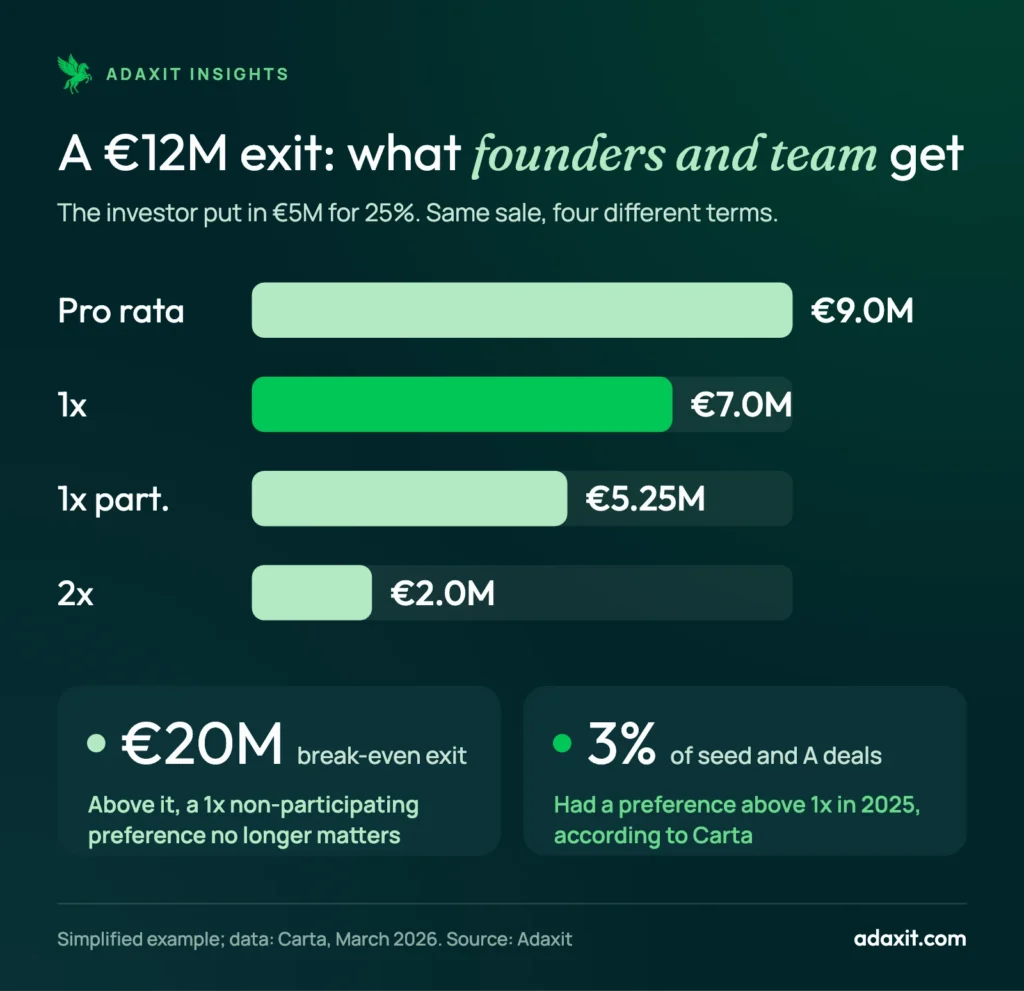
An investor put €5M into the company for 25%, so the post-money valuation was €20M. Two years later the company is sold for €12M. Here’s how the money splits.
| Term | Investor gets | Everyone else gets |
|---|---|---|
| No preference (pro rata) | €3.0M | €9.0M |
| 1x non-participating | €5.0M | €7.0M |
| 1x participating | €6.75M | €5.25M |
| 2x non-participating | €10.0M | €2.0M |
With 1x non-participating the investor compares €5M (the preference) with €3M (25% of the sale) and takes the €5M. With participation they take the €5M and then 25% of the remaining €7M. At 2x, the preference alone swallows €10M of the €12M.
When the preference stops mattering
With 1x non-participating there’s a break-even point: the investor’s money divided by their percentage. Here that’s €5M ÷ 25% = €20M, the same as the post-money valuation. Sell for more than €20M and converting to common pays the investor more than the preference, so everyone is paid in proportion to what they own.
Below that point, the preference decides the split. Participating preferred never stops mattering unless it has a cap: the investor keeps the first €5M at any price.
What’s market, and what to push back on
In Carta’s figures, published in March 2026, only 3% of seed and Series A deals in 2025 had a liquidation preference above 1x, and participation is very uncommon at the early stages. If a term sheet asks for either, you’re entitled to ask why.
- Treat 1x non-participating as the norm for seed and Series A.
- Push back on participation, or ask for a cap so it stops at, say, 3x the investment.
- Watch the stack in later rounds: each class can have its own preference, paid one after another (senior) or side by side (pari passu).
- Run the numbers at a few exit prices before you sign, not after.
The preference works together with your ownership, so it helps to be sure what you’ll own: see pre-money vs post-money valuation and what fully diluted means. If you’re raising in Italy, our guide to raising capital in Italy covers who invests at each stage.
What is a 1x liquidation preference?
It means the investor is entitled to get back the amount they invested, once, before common shareholders are paid in a sale or liquidation. With non-participating terms they can take their percentage instead if it’s worth more.
What is participating preferred?
Preferred shares that get the preference and then also share in the remaining proceeds as if they had converted. It’s sometimes called double dipping and is uncommon at seed and Series A.
Is a 2x liquidation preference normal?
No. Carta’s data shows only 3% of seed and Series A deals had a preference above 1x in 2025.
Does the liquidation preference matter in a large exit?
With 1x non-participating, not once the sale price is above the investor’s money divided by their percentage. Above that, the investor converts and everyone is paid pro rata.
Investor-Ready Kit
Test your own exit: the cap table simulator in our Investor-Ready Kit includes an exit waterfall with liquidation preferences for each round.
Sources
For information only: this is not investment advice or a public offer.