If you sell to Brazil, Argentina, Uruguay or Paraguay, 1 May 2026 was a good day. That’s when the interim EU–Mercosur trade agreement started applying provisionally, after a signing ceremony in Asunción on 17 January 2026 and more than a quarter of a century of on-and-off negotiation. For a lot of products, exporting got a little cheaper overnight.
The real question for an Italian SME is more down to earth. By how much does the duty on your product fall? From when? And what paperwork do you need to actually get the lower rate? For some goods the benefit is immediate. For others it’s a slow drip: the cut comes in instalments, typically spread across ten years (fifteen for a few sensitive lines).
So here’s what we’ll go through, all checked as of 1 October 2026: where the deal actually stands, how the tariff cuts are timed, the origin rules that trip people up, the support you can tap into, and a short checklist. We’ve put the official sources at the end, so you can verify every number yourself.
Key takeaways
- The interim agreement has applied provisionally with all four Mercosur countries since 1 May 2026. The broader partnership agreement still needs ratifying.
- Once fully phased in, duties disappear on 91% of EU exports to the bloc, mostly within ten years. The first cut is already live.
- You’ll need a statement on origin, plus REX registration once a shipment carries more than €6,000 of originating goods.
- 57 Italian geographical indications are protected, from Parmigiano Reggiano to Prosecco, though some names come with transition periods and carve-outs.
- Before anything else, look up your customs code, tariff schedule and rule of origin on Access2Markets.
Planning a first market outside Italy? Our market entry strategy guide covers the questions to answer before you spend, and expanding into Latin America looks at the region country by country.
Where things stand: what’s in force, what isn’t
Two legal texts sit behind the headlines. Exporters mostly need the first one, the interim trade agreement (iTA), which handles tariffs, rules of origin, services, public procurement and intellectual property. The second, the partnership agreement (EMPA), covers political dialogue and cooperation, and will eventually take over from the iTA. Both involve the four founding members of Mercosur.
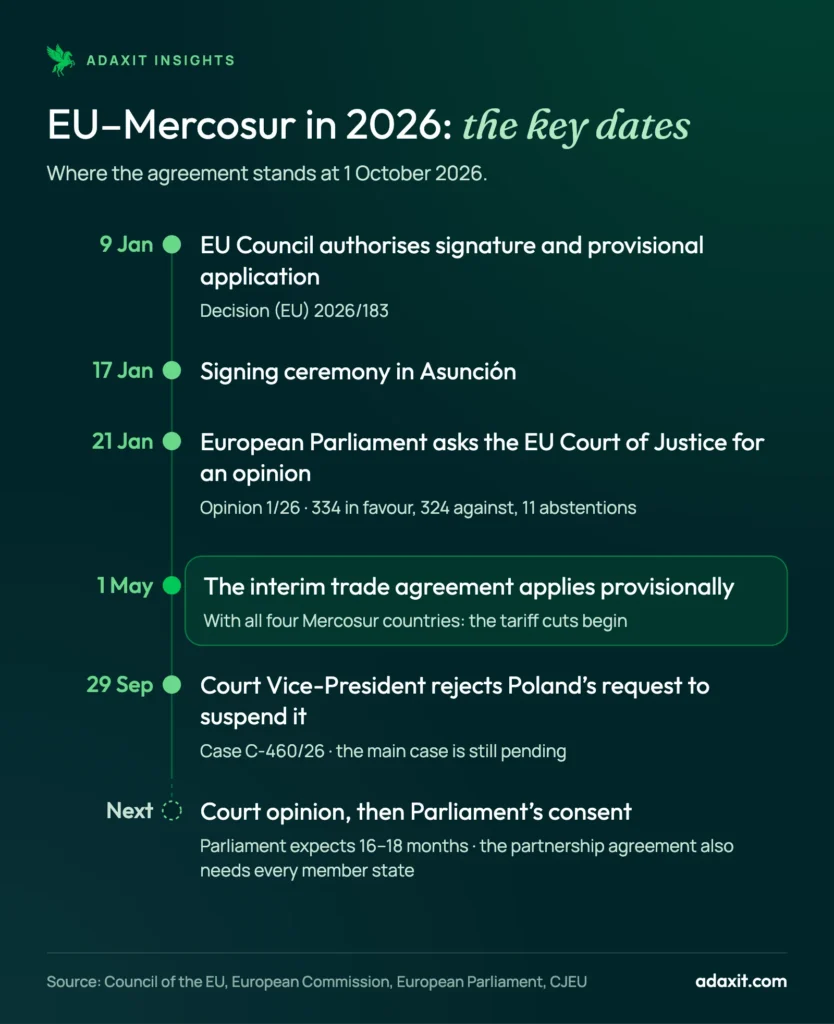
The Council of the EU signed off on the signature and provisional application of the iTA through Decision (EU) 2026/183 of 9 January 2026. Once the four South American governments had ratified their side, provisional application kicked in on 1 May 2026, with all four at once.
| Instrument | Status at 1 October 2026 | What is missing |
|---|---|---|
| Interim trade agreement (iTA) | Provisionally applied since 1 May 2026 with the four Mercosur countries | European Parliament consent for formal conclusion |
| Partnership agreement (EMPA) | Signed on 17 January 2026, not yet in force | European Parliament consent and ratification by all member states; it will then replace the iTA |
| Opinion of the EU Court of Justice | Requested by the European Parliament on 21 January 2026 (Opinion 1/26) | Pending the opinion, Parliament’s consent procedure is suspended |
Brussels hasn’t gone quiet, mind you. Back on 21 January 2026, MEPs voted to send both agreements to the Court of Justice and ask whether they’re compatible with the EU Treaties (that’s Opinion 1/26). It scraped through by ten votes, 334 to 324, with 11 abstentions. Parliament says the request freezes its own approval procedure for 16 to 18 months, which didn’t stop the Commission from pressing ahead with provisional application. Poland went further and challenged Decision (EU) 2026/183 in court (case C-460/26). On 29 September 2026 the Court’s Vice-President turned down Poland’s request to suspend provisional application; the main case is still open.
Safeguards, and why farmers are unhappy
Agriculture is where the fight is. For sensitive products like beef, poultry and sugar, Mercosur goods only get preferential rates within quotas, and the beef quota, by the Commission’s reckoning, works out at 1.5% of EU production. On top of that, Regulation (EU) 2026/687 applies alongside the iTA: if imports of a sensitive product climb 5% above the three-year average, an investigation can be opened, and it has to be wrapped up within four months. Italy’s foreign ministry points out that Rome secured beefed-up safeguard clauses for certain supply chains.
Tariffs: the timetable for Made in Italy sectors
270 million
people in the four Mercosur countries
€16.4bn
Italy–Mercosur trade (goods 2024, services 2023)
57
Italian geographical indications protected
Source: European Commission, factsheets on the EU–Mercosur agreement (general and Italy factsheets).
Once everything has phased in, the agreement wipes out duties on 91% of what the EU sells to Mercosur. Most products get there within ten years; a few sensitive ones take up to fifteen. The Commission puts the saving for European exporters at more than 4 billion euros a year.
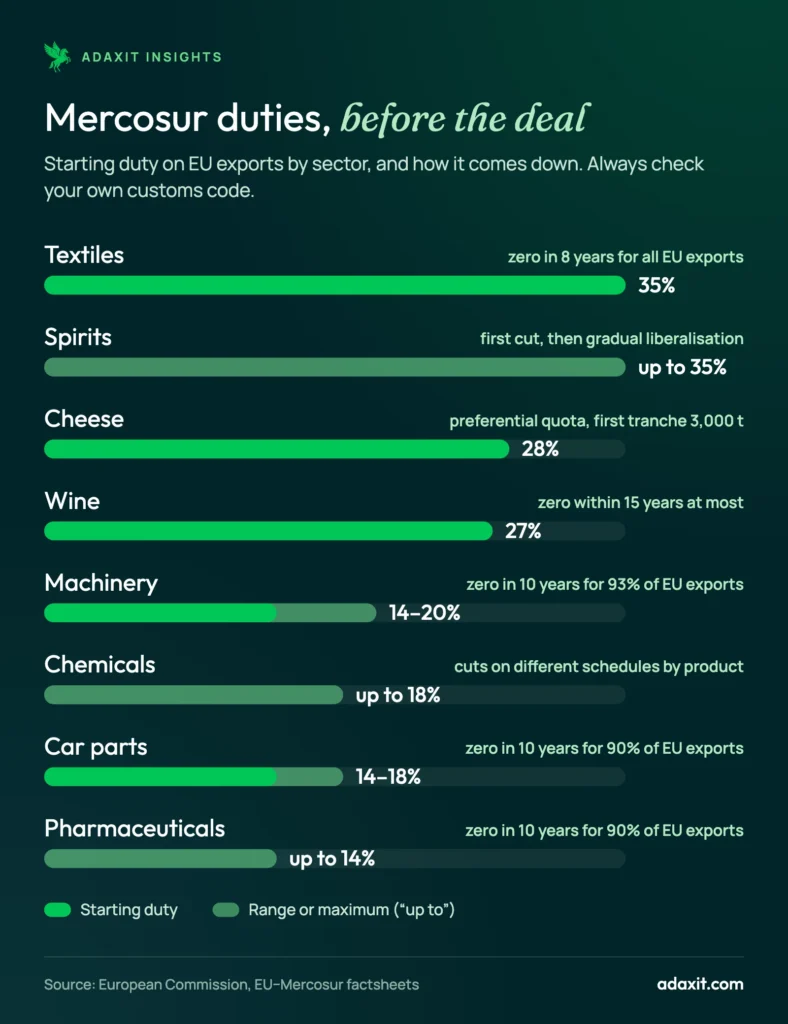
Timing is the part people misread. What happened on 1 May 2026 was only the first instalment for most products; the rest of the cut comes later. For Italian companies, the bigger money sits in industry. In 2024 they shipped 3.1 billion euros of machinery and electrical equipment to Mercosur, plus 1.2 billion of chemicals and pharma. Agri-food, for all the attention it gets, came to 489 million.
| Sector | Starting Mercosur duty | What the agreement provides |
|---|---|---|
| Machinery and equipment | 14–20% | Zero within ten years for 93% of EU exports; first cut of 1.3–1.7 points |
| Car parts | 14–18% | Zero within ten years for 90% of EU exports; first cut of 1.3% to 1.6% |
| Pharmaceuticals | Up to 14% | Ten-year path to zero for 90% of EU exports; first cut of up to 1.3 points |
| Chemicals | Up to 18% | Reductions on different schedules by product: check your code |
| Textiles | 35% | Eight-year path to zero for all EU exports; first cut of 3.9 points |
| Wine | 27% | First cut, then full liberalisation within 4, 8, 10 or 15 years depending on the product; high-end sparkling wine liberalised from day one |
| Spirits | Up to 35% | First cut, then gradual liberalisation |
| Cheese | 28% (dairy) | Preferential tariff quota opened in tranches: the first is 3,000 tonnes |
Fashion. Textiles hit zero after eight years. For clothing and leather shoes, the Commission’s 2019 figures showed duties as high as 35%.
Agri-food. Before the deal, Mercosur charged anywhere from 27% to 55% on Italian food and drink. Wine, spirits, olive oil, pasta, chocolate and beer have already had a first cut and will be fully liberalised within 4, 8, 10 or 15 years at most. Cheese, milk powder and infant formula take a different route: quotas.
Rules of origin: proving your product is European
Here’s the bit that catches people out: the lower duty doesn’t apply by itself. Your product has to qualify as EU-originating under the specific rule for its code, and the importer needs proof of origin at the border. The importer usually handles customs. The proof, though, is your job.
On exports out of the EU there’s exactly one accepted proof, the statement on origin, which you as the exporter write yourself, using the wording the agreement prescribes. You can put it on the invoice, on the delivery note or on any other commercial document, and it’s good for 12 months. The Commission’s guidance adds a few practical rules:
- ship more than 6,000 euros’ worth of originating products in one consignment and you must be registered in the REX system, with your number on the statement;
- below that, you can make the statement without registering;
- to register for REX, use the EU Trader Portal or go through your local customs office;
- keep every statement and its supporting paperwork on file; three years is the minimum.
Not sure about your own product? The ROSA tool on Access2Markets takes you through the rule step by step. One limitation worth knowing: the agreement only allows bilateral cumulation, so Mercosur-made materials count as originating but inputs from third countries don’t. As for non-originating materials, you’re generally allowed up to 10% of the ex-works price, though textiles and clothing (chapters 50–63) play by their own rules.
Adaxit note
“Made in Italy” and preferential origin are two different things. A machine assembled in Italy from lots of non-EU parts can easily fail the origin test. Check before you quote a price to your distributor, not after.
Geographical indications, public tenders and services
Geographical indications. Of the 344 European GIs that Mercosur has agreed to protect, 57 are Italian, and Parmigiano Reggiano, Grana Padano, Prosciutto di Parma, Prosecco and Barolo are all on the list. Not every name is protected from day one, though. In parts of Mercosur, local makers get 5, 7 or 10 years during which they can go on using the same name, or one that’s close to it. And the list is longer than you’d expect. For cheese that means names like Grana Padano, Gorgonzola, Asiago, Taleggio and Pecorino Romano. Cured meats? Prosciutto di Parma and Mortadella Bologna. Wines and spirits? Prosecco, Asti and Grappa. Some prior users named in the agreement can also carry on using terms like Parmesano, Reggianito and Fontina (and, in Brazil, Grana and Gorgonzola) under certain conditions. Look your name up on the Commission’s Italy factsheet, then check the agreement’s annexes for any exceptions.
Public procurement. Argentina and Uruguay open their federal tenders; Brazil opens federal and sub-central ones, with some exceptions. Paraguay follows within three years.
Services. EU firms can set up shop and sell most services on the same footing as local and foreign rivals. Finance, telecoms, transport, postal, digital and environmental services are all part of the opening. Italy already sells 1.9 billion euros of services a year into Mercosur.
Seven practical steps
- Classify the product. Get the customs code wrong and you’ll misread both the duty and the origin rule. Mercosur works with its own common nomenclature, the NCM.
- Look up the duty and the timetable. Access2Markets has a tool called My Trade Assistant, available in every EU language: type in your code and it tells you the duty, the origin rule and the other requirements. One catch, though. The deal cuts customs duties, and the domestic taxes charged on imports don’t move.
- Pick your market. Brazil is the biggest prize and often the toughest. Going one country at a time tends to work better than a big-bang launch.
- Sort out registrations. Plenty of products need approval in Brazil before they can be sold: think ANVISA for medicines, medical devices, cosmetics and some foods, MAPA for wine, drinks and animal products, or INMETRO certification. None of that goes away with the agreement.
- Choose your partner carefully. Importer, distributor or agent: check references and how solid they are financially. After that, get it on paper: who handles the documents, and who’s paying the duties, taxes and other costs.
- Make sure you get paid. Settle the Incoterms and the payment terms before anything ships. A letter of credit or credit insurance is worth considering, and so is the currency risk.
- Speak their language. That means Portuguese in Brazil and Spanish in the other three. Doing price lists, data sheets, labels and meetings in the local language can easily save you months.
Adaxit note
Who keeps the duty saving? Normally the importer pays the duty, so the benefit won’t land in your account on its own. Decide early whether you’ll pass it on as a lower price, use it to co-fund marketing with your distributor or keep it as margin, and get that agreed in writing.
Cross-border expansion
Duties and rules of origin for your product in one week, then up to 10 pre-selected potential partners and a meeting agenda in Portuguese or Spanish. A tailored proposal after a free 20-minute call.
Public support: SIMEST, ICE and SACE
Three Italian public bodies can help finance the move and cover the risk.
- SIMEST (part of the CDP group) runs the subsidised loans of Fund 394/81 for internationalisation, including financing to enter foreign markets. A few of them even include a portion you don’t have to pay back. Just don’t plan around last year’s numbers: SIMEST changes percentages, caps and rates whenever a new circular comes out.
- ICE Agency is the one to call for promotion abroad, from trade fairs and trade missions to B2B meetings.
- SACE insures export credit and guarantees financing for international growth, which helps if you offer customers payment terms.
If the expansion needs fresh capital, our guide on how to raise capital in Italy is a good next read. An EU–Mercosur playbook e-book is also in preparation among our resources.
Checklist before the first shipment
- You’ve confirmed the customs code, today’s duty and the phase-out schedule on Access2Markets.
- You’ve run the rule of origin through ROSA and gathered the supporting documents.
- Your EORI number is active, you’re in REX if a single consignment will top 6,000 euros, and the statement on origin wording is ready to paste.
- You know which local approvals apply to you, whether that’s ANVISA, MAPA, INMETRO or another body.
- Your labels and technical documents exist in Portuguese for Brazil and in Spanish for the other three.
- You’ve vetted your local partner, and the contract spells out who deals with customs.
- Incoterms, payment terms and credit cover are agreed.
- In food and drink? Then you’ve checked your geographical indication against the list of 57, transition periods and exceptions included.
Let’s talk
Let’s work out together whether Mercosur is the right market for your product, in English, Italian, Portuguese or Spanish.
Questions exporters ask
Is the EU–Mercosur agreement in force yet?
Partly. Strictly speaking, neither agreement has formally entered into force, but the interim trade agreement has applied provisionally with all four Mercosur countries since 1 May 2026, so the tariff preferences can be used today. The partnership agreement still needs the European Parliament’s consent (on hold until the Court of Justice gives its opinion) and ratification by member states. Poland’s legal challenge against the Council decision is also pending; so far it hasn’t suspended anything.
What do I need to do to get the reduced duty?
Your product has to meet the agreement’s rules of origin, and each shipment needs a statement on origin, valid for 12 months. Ship more than 6,000 euros of originating products at once and you’ll also need REX registration, with your number on the statement.
Are my PDO and PGI products protected in Mercosur?
If your name is one of the 57 Italian GIs in the agreement, Mercosur countries have committed to protecting it against imitations. Some names, however, come with 5-, 7- or 10-year transition periods, or let prior users keep terms like Parmesano or Fontina under certain conditions. The European Commission’s Italy factsheet is the place to check.
Does the agreement matter for service companies and public tenders?
Yes. It opens public procurement in Argentina and Uruguay at federal level and in Brazil at sub-central level too, with some exceptions; Paraguay follows within three years. On services, EU companies can offer most of them on the same terms as local and foreign competitors.
Sources
- European Commission — EU trade relations with Mercosur, accessed 1 October 2026
- European Commission — Factsheet: how to export goods and services, accessed 1 October 2026
- European Commission — Factsheet: how to export agricultural goods, accessed 1 October 2026
- European Commission — Factsheet: EU-Mercosur Partnership Agreement: Italy, accessed 1 October 2026
- European Commission — Factsheet: EU-Mercosur partnership agreement, accessed 1 October 2026
- European Commission — Key elements of the EU-Mercosur trade agreement (2019), accessed 1 October 2026
- European Commission (DG TAXUD) — EU-Mercosur ITA: guidance on rules of origin, accessed 1 October 2026
- Access2Markets — EU-Mercosur Partnership Agreement and interim Trade Agreement, accessed 1 October 2026
- Access2Markets — Application of EU-MERCOSUR interim Trade Agreement on 1 May 2026, accessed 1 October 2026
- Council of the EU — EU-Mercosur: Council greenlights signature, accessed 1 October 2026
- Council of the EU — EU-Mercosur: Council greenlights safeguards, accessed 1 October 2026
- EUR-Lex — Council Decision (EU) 2026/183 of 9 January 2026, accessed 1 October 2026
- EUR-Lex — Notice on the provisional application of the EU–Mercosur interim trade agreement (2026/868), accessed 1 October 2026
- EUR-Lex — Regulation (EU) 2026/687 of 11 March 2026 on safeguards for agricultural products, accessed 1 October 2026
- Council of the EU — EU–Mercosur interim agreement, annexes 13-B and 13-E on geographical indications and prior users (doc. ST 12413/25 ADD 14), accessed 1 October 2026
- European Parliament — Legislative Train: EU-Mercosur trade pillar, accessed 1 October 2026
- Court of Justice of the EU — Press release no. 135/26, case C-460/26 R, Poland v Council, accessed 1 October 2026
- Ministry of Foreign Affairs of Latvia — Provisional application of the EU-Mercosur ITA, accessed 1 October 2026
- Italian Ministry of Foreign Affairs — EU-MERCOSUR Agreement Highlights, accessed 1 October 2026
- SIMEST — Subsidised loans, in Italian, accessed 1 October 2026
For information only: this is not investment advice or a public offer.